privatewelldata / States / North Carolina / Arsenic
Arsenic in well water in North Carolina
4% of 340 sampled wells in North Carolina had arsenic above the EPA limit of 10 µg/L (latest result per well, 12 counties, samples 1980–2022). The highest county share was Craven County: 14% of 49 wells. Data updated 2026-10-18.
of sampled wells above 10 µg/L
wells with a result
counties with data
counties where 1 in 4+ wells were above
Arsenic in wells usually comes from the rock and sediment the water passes through, so it can vary a lot between neighbouring wells. You cannot see, smell or taste it; only a lab test shows it. Federal limits apply to public water systems; a private well is the owner's responsibility to test (EPA).
% of sampled wells above the EPA limit (latest result per well; counties with 10+ wells). Source: USGS/EPA Water Quality Portal, 2026-10-18 · privatewelldata.com
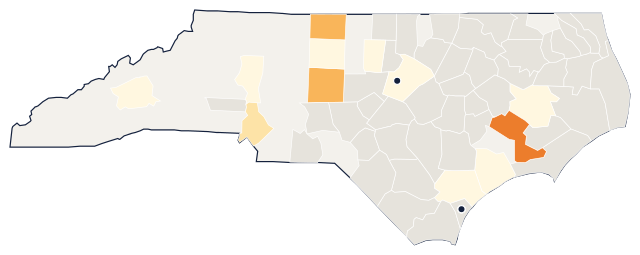
Arsenic by county in North Carolina
| County | Above 10 µg/L | Median | 90th pct. | Years |
|---|---|---|---|---|
| Craven County | 14% of 49 | 1 µg/L | 14 | 1986–2022 |
| Randolph County | 7% of 14 | 0.25 µg/L | 0.93 | 2007–2014 |
| Rockingham County | 5% of 19 | 0 µg/L | 4 | 2002–2007 |
| Mecklenburg County | 4% of 96 | 0 µg/L | 1 | 1980–1994 |
| Guilford County | 0% of 33 | 0 µg/L | 0.07 | 1996–2007 |
| Orange County | 0% of 33 | 0 µg/L | 1 | 1998–2007 |
| Iredell County | 0% of 23 | 0 µg/L | 0 | 2002–2014 |
| Wake County | 0% of 22 | 0 µg/L | 0.36 | 2001–2007 |
| Buncombe County | 0% of 17 | 0 µg/L | 0 | 2003–2014 |
| Beaufort County | 0% of 14 | 0.02 µg/L | 0.21 | 1994–2022 |
| Onslow County | 0% of 10 | 0 µg/L | 0.2 | 2002–2021 |
| Pender County | 0% of 10 | 0.025 µg/L | 0.3 | 2002–2022 |
No rows match these filters. Try fewer words or clear the filters.
Download this table (CSV) · public-domain source data: Water Quality Portal (USGS, EPA, NWQMC). How we calculate these numbers.
How North Carolina compares
Share of sampled wells above the EPA arsenic limit in each state we cover (states with 100+ wells).
| # | State | Above 10 µg/L |
|---|---|---|
| 1 | Maine | 59% of 261 |
| 2 | Minnesota | 19% of 5,914 |
| 3 | Michigan | 15% of 1,077 |
| 4 | Ohio | 15% of 620 |
| 5 | New Hampshire | 14% of 863 |
| 6 | California | 14% of 8,314 |
| 7 | Massachusetts | 8% of 474 |
| 8 | Pennsylvania | 4% of 3,072 |
| 9 | North Carolina | 4% of 340 |
| 10 | Wisconsin | 3% of 610 |
| 11 | New Jersey | 2% of 2,227 |
| 12 | New York | 2% of 3,544 |
| 13 | Virginia | 1% of 298 |
Where to test: official lab list for North Carolina
About this data
- Each well counts once, using its latest arsenic result in the Water Quality Portal (siteType = Well), downloaded 2026-10-18.
- Results reported as "not detected" count as below the limit. Results far outside the plausible range are withheld for review, not shown.
- Sampled wells include monitoring and research wells, not only household wells, and are not a random sample, so the share is a guide to local risk, not a rate for all homes.
- The limit is the EPA maximum contaminant level for public water systems (EPA).
Questions
Is arsenic common in North Carolina well water?
In our data, 13 of 340 sampled wells in North Carolina (4%) had a latest arsenic result above the EPA limit of 10 µg/L, across 12 counties. That ranks North Carolina 9 of 13 states we cover for this share.
Which North Carolina counties have the most wells above the arsenic limit?
Among counties with at least 10 sampled wells: Craven County (14%, 7 of 49 wells); Randolph County (7%, 1 of 14 wells); Rockingham County (5%, 1 of 19 wells).
Does this tell me whether my well is safe?
No. These are past results from wells sampled by USGS, EPA and state programs, including monitoring wells, and levels differ from well to well. The only way to know your water is to test your own well at a certified lab.
How do I test my well for arsenic in North Carolina?
Order a arsenic test from a lab on North Carolina's official certified-lab list (linked on this page) and ask for its bottles and sampling instructions. Our test helper suggests what else to test for at the same time.
What should I do if my arsenic result is above 10 µg/L?
Retest to confirm, use another water source for drinking and cooking while you sort it out, and look at certified treatment options. Our guide walks through each step with sources.